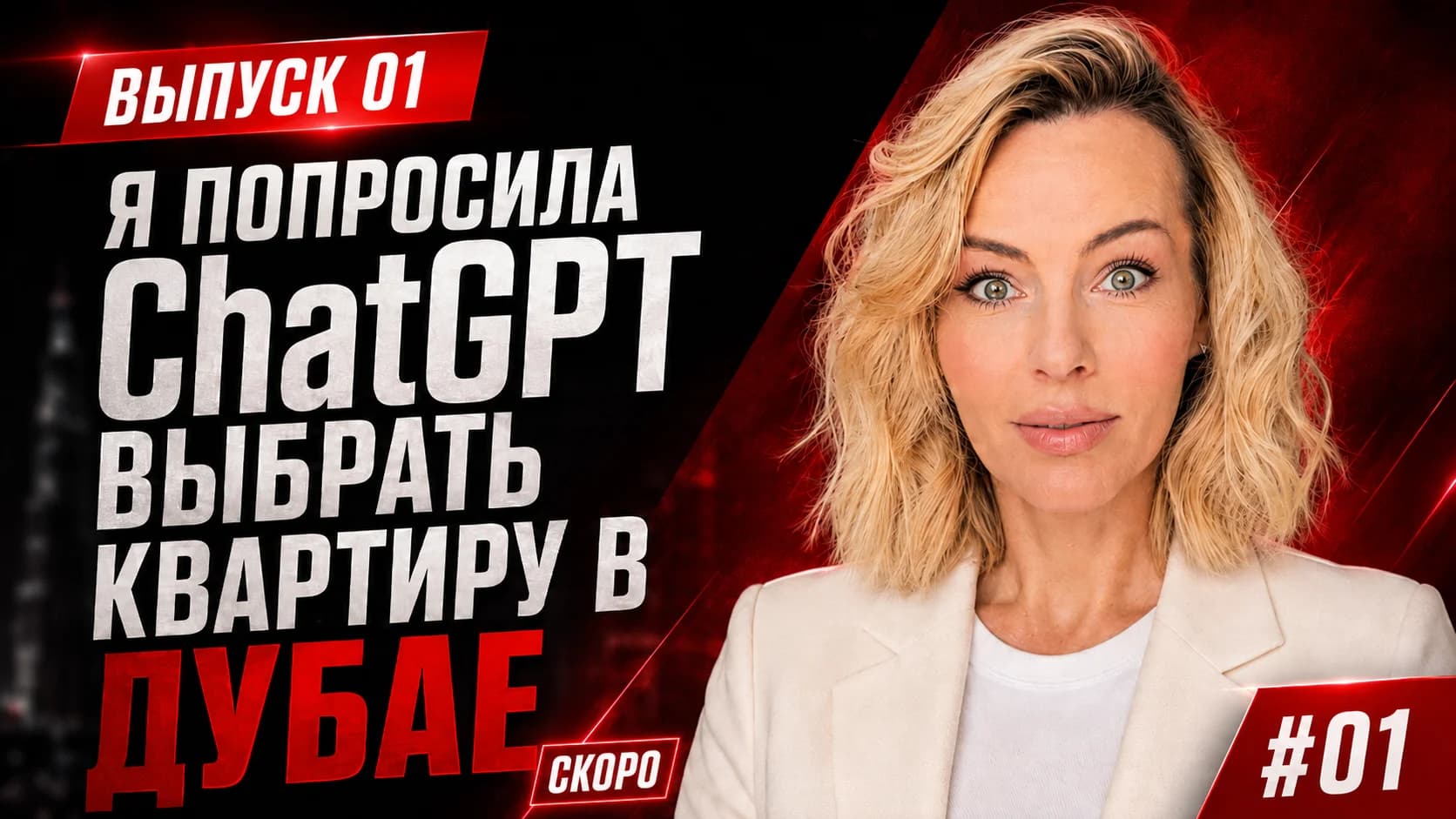
Featured episodeComing soon
I Asked ChatGPT to Pick an Apartment in Dubai

Demand → trust → deals
My name is Nika Boenko. Welcome to my site.
I work with developers and real estate agencies, finding the points where money is lost between a client's first enquiry and the signed deal.
I go through the client journey, the CRM, the sales team and the whole commercial process first — and only then decide where AI genuinely delivers speed, data and control.
I'm Nika Boenko. My professional territory today is AI in real estate. I work on what happens between a client's first enquiry and the signed deal: sales, CRM, negotiation, follow-up, analytics, and how the sales team actually operates.
I've spent more than 25 years in sales and marketing — from selling myself, to running businesses, to consulting and working with commercial teams. My strength was never advertising. It was the sale itself: complex, expensive, multi-stage deals where the outcome depends on dozens of decisions between first contact and a signed contract.
I've worked in real estate since 2018, starting as a sales and business development consultant. Turkey is one of my key markets and still is today. Along the way there have been Russian and international projects, agencies and brokerages, country and resort property, B2B sales, and training agents.
For years I've worked not only as an entrepreneur and consultant but as a speaker and business trainer — training owners, executives and sales teams, running programmes on negotiation and complex selling, including for the real estate market.
Real estate shows the cost of a bad sale more clearly than most markets. You can spend heavily on marketing, generate the lead, and still lose the client later: a slow reply, weak qualification, a poor call, no follow-up, or chaos in the CRM. The money goes after marketing has already done its job.
That's why I never open with "let's implement AI". I listen to real calls, read real message threads, go through the CRM, the funnel, the sales team and the whole client journey. I find the specific points of loss. Only then do I decide what has to change in the sales system itself, and where AI will genuinely give the business speed, data and control. From there my team takes implementation forward.
My position is simple. AI shouldn't replace a strong salesperson. It should take the routine off their hands and give them more information, speed and control — and leave the human with what they're still better at than any technology: trust, reading the client, and negotiation.
Alongside building AI systems in real estate, I build my own companies and digital products with my partners.
The company I run with my partners. Mehanika is my delivery team: we design and implement AI systems, automation and digital products for businesses.


An AI product for women 40+ that brings data on wellbeing, habits and lifestyle together into one clear personal system.
I don't start with technology. I start with the money: where exactly a company loses it between the first enquiry and the deal. My team works on specific points of loss, not on an abstract "AI rollout".
The client contacts three companies. The one that replies first gets the conversation. The rest paid for that lead and got nothing.
A salesperson spends weeks on someone who will never buy, and loses the one who was ready.
The call happened, but nothing was agreed: no date set, no real question asked, no clear next step.
The client never said no. They just stopped replying, and nobody came back to them.
Thousands of contacts and deals sit in the system, and nobody knows what to do with them today.
Nobody can show which step the deal actually fell apart on. Decisions get made blind.
This isn't a finished product line. These are the directions I examine in a diagnostic, and the ones my team implements where the numbers hold up.
I test how AI helps identify, faster and more accurately, who is genuinely ready to transact.
I close the gap between a client's enquiry and the first real reply from a person.
I work out what AI can genuinely hear in conversations between salespeople and clients — and what still only a human should hear.
I turn accumulated contacts into a source of deals rather than dead weight.
I don't sell a ready-made solution. First I go through your current sales system and find where exactly the company is losing money. Only then do I decide what has to change in the process itself, and what is worth strengthening with AI.
You can act on the diagnostic yourself. If you decide to go further, my team steps in: we rebuild the process and implement AI where it earns its place.
I go through the client journey, the funnel, the CRM, calls, messages and how the sales team actually works — on real data, not on a description of the process.
I identify where the company is losing leads, speed, quality of contact and deals.
First I fix the mechanics of selling: roles, scripts, follow-up, CRM, data and control.
Only now do I decide where AI genuinely strengthens the process — qualification, call analysis, analytics, next-best-action, follow-up. From there my team implements it and turns it into a repeatable system.
MANIFESTO
AI can add speed, precision and control to real estate sales — but only when it's built into a strong commercial system. Strong marketing, a strong salesperson, and AI have to work as one revenue engine.
On YouTube I test how AI actually performs in real estate: I try the tools, look at how developers and agencies work, and go through the client journey, CRM, sales, property matching and automation. Real experiments and breakdowns — what works and what doesn't.
I don't add another AI tool on top of the chaos. First I find where money is actually lost between the enquiry and the deal — response speed, qualification, follow-up, the gap between marketing and sales, the unworked database. Then we rebuild the process itself, and only then do we put AI into the specific points where it produces a measurable effect.
With a revenue leakage diagnostic — a paid strategy session where I go through your current path from enquiry to deal and show the specific points of loss and what to prioritise. It's the starting point for anything that follows, not a standalone service.
Both, in that order: analysis and decisions first, then — where it's justified — real implementation with my team. I don't sell AI for the sake of AI, and I don't start with the technology.
Trust and negotiation. AI takes on speed, data, routine and process control — but the client's decision to trust you, rather than simply to buy, is still made by a person. I don't build systems that replace salespeople. I make strong ones stronger.
Usually not. I look first at what's already in your CRM and how it's used — very often the functionality is there and simply isn't configured. Replacing the system is a last resort, not a first step.
I work with company data only to the extent the diagnostic and the specific project require, and I never show one client's data to another. Data processing and confidentiality terms are agreed separately at the start, before any information changes hands.
Yes — and that's usually the right first step. We often start with one process, such as call analysis or reactivating an old database, over 30–60 days, to see a real result before talking about scale.
No. I work with Russian and international projects; Turkey is one of my key markets. If you're based outside Russia, get in touch and we'll see whether your market and your problem fit my current focus.
We'll go through your path from a client's first enquiry to the signed deal: where leads come from, where money is actually lost, and where AI can give you speed, data and control. The specific result depends on your system — I don't promise a guaranteed percentage lift.
What you'll get

